A Comparative Study of Input Modalities for PrecisionCutting in Virtual Reality
David Mertens, Alisa Rüge, Turhan Civelek und Arnulph Fuhrmann
In: Virtuelle und Erweiterte Realität – 23. Workshop der GI-Fachgruppe VR/AR, 2026

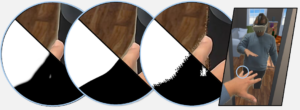
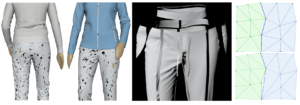
Quest 3 controller, Geomagic Touch without force feedback, and Geomagic Touch with force feedback.
Bottom: progression of a cutting trial along the predefined target path. The skin is simulated as
a two-dimensional XPBD surface and folds back during cutting, revealing the gray table surface
underneath.
Abstract
Precision cutting in virtual reality requires continuous control of tool trajectory and tissue contact, yet standard VR controllers provide little kinesthetic information. We compared a Meta Quest 3 controller, a Geomagic Touch without force feedback, and the same device with active force feedback in an Extended Position-Based Dynamics tissue-cutting simulation. Five participants traced predefined paths in a within-subject pilot study. Outcomes were mean absolute error, peak deviation, completion time, usability, and workload. Descriptively, force feedback produced the lowest cutting errors, highest usability, and lowest workload. These preliminary findings suggest that kinesthetic cues may support precision cutting.
Paper
 Preprint: