
Investigating the Effect of Embodied Visualization in Remote Collaborative Augmented Reality
Kristoffer Waldow, Arnulph Fuhrmann and Stefan M. Grünvogel In: Proceedings…
Kristoffer Waldow, Arnulph Fuhrmann and Stefan M. Grünvogel In: Proceedings…
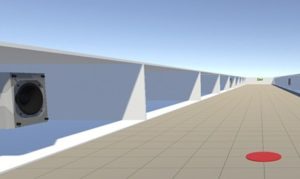
We investigate the influence of four different audio representations on visually induced self-motion (vection). Our study followed the hypothesis, that the feeling of visually induced vection can be increased by audio sources while lowering negative feelings such as visually induced motion sickness.
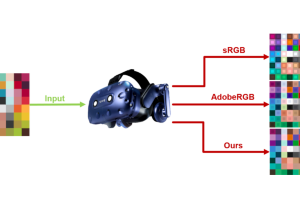
When rendering images in real-time, shading pixels is a comparatively expensive
operation. Especially for head-mounted displays, where separate images are rendered for
each eye and high frame rates need to be achieved. Upscaling algorithms are one possibility
of reducing the pixel shading costs. Four basic upscaling algorithms are implemented in a
VR rendering system, with a subsequent user study on subjective image quality. We find
that users preferred methods with a better contrast preservation.
In this paper, we present a Mixed Reality telepresence system that allows the connection of multiple AR or VR devices to create a shared virtual environment by using the simple MQTT networking protocol. It follows a subscribe-publish pattern for reliable and easy platform independent integration. Therefore, it is possible to realize different clients that handle communication and allow remote collaboration. To allow embodied natural human interaction, the system maps the human interaction channels, gestures, gaze and speech, to an abstract stylized avatar by using an upper body inverse kinematic approach. This setup allows spatially separated persons to interact with each other via an avatar-mediated communication.
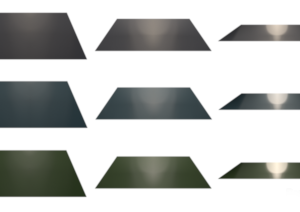
The simulation of light-matter interaction is a major challenge in computer graphics. Particularly challenging is the modelling of light-matter interaction of rough surfaces, which contain several different scales of roughness where many different scattering phenomena take place. There are still appearance critical phenomena that are weakly approximated or even not included at all by current BRDF models. One of these phenomena is the reddening effect, which describes a tilting of the reflectance spectra towards long wavelengths especially in the specular reflection. The observation that the reddening effect takes place on rough surfaces is new and the characteristics and source of the reddening effect have not been thoroughly researched and explained. Furthermore, it was not even clear whether the reddening really exists or the observed effect resulted from measurement errors. In this work we give a short introduction to the reddening effect and show that it is indeed a property of the material reflectance function, and does not originate from measurement errors or optical aberrations.
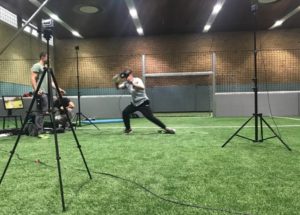
Um die Attraktivität des Antizipations- und Reaktionstrainings für jugendliche Torwarte zu erhöhen war es das Ziel eine sportartspezifische Umgebung in virtueller Realität (VR) zu entwickeln.
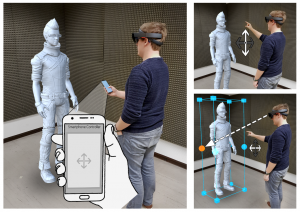
In Augmented Reality, interaction with the environment can be achieved with a number of different approaches. In current systems, the most common are hand and gesture inputs. However experimental applications also integrated smartphones as intuitive interaction devices and demonstrated great potential for different tasks. One particular task is constrained object manipulation, for which we conducted a user study. In it we compared standard gesture-based approaches with a touch-based interaction via smartphone. We found that a touch-based interface is significantly more efficient, although gestures are being subjectively more accepted. From these results we draw conclusions on how smartphones can be used to realize modern interfaces in AR.
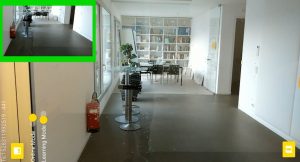
The ability to localize a device or user precisely within a known space, would allow many use cases on the context of location-based augmented reality. We propose a localization service based on sparse visual information using ARCore, a state-of-the-art augmented reality platform for mobile devices.
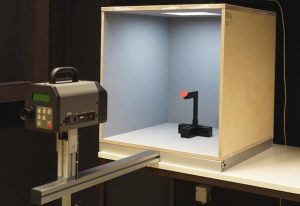
In this work, we acquired a set of precisely and spectrally resolved ground truth data. It consists of the precise description of a new developed reference scene including isotropic BRDFs of 24 color patches, as well as the reference measurements of all patches under 13 different angles inside the reference scene.
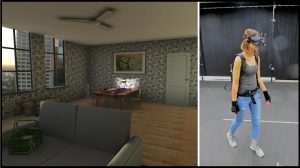
For locomotion in virtual environments (VE) the method of redirected walking (RDW) enables users to explore large virtual areas within a restricted physical space by (almost) natural walking. The trick behind this method is to manipulate the virtual camera in an user-undetectable manner that leads to a change of his movements. If the virtual camera is manipulated too strong then the user recognizes this manipulation and reacts accordingly. We studied the effect of human perception of RDW under the influence of the level of realism in rendering the virtual scene.
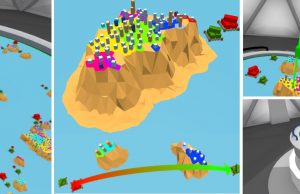
We present an approach for exploring OSGi-based software systems in virtual reality. We employ an island metaphor, which represents every module as a distinct island. The resulting island system is displayed in the confines of a virtual table, where users can explore the software visualization on multiple levels of granularity by performing intuitive navigational tasks. Our approach allows users to get a first overview about the complexity of an OSGi-based software system by interactively exploring its modules as well as the dependencies between them.
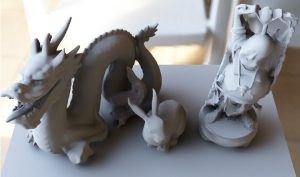
We present a new, physically plausible, real-time approach to compute directional occlusion for dynamic objects, lit with image based
lighting.
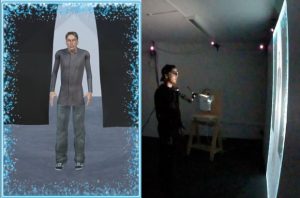
In this paper, we present SIAM-C, an avatar-mediated communication platform to study socially immersive interaction in virtual environments.
The following paper investigates the effect on the intensity of perceived vection by changing the field of view (FOV) using a headmounted
display (HMD) in a virtual environment (VE).
Recent advances in real-time rendering enable virtual production pipelines in a broad range of industries. These pipelines are based on a fast, latency-free handling in addition to the accurate appearance of results. This requires the use of high dynamic range rendering for photo-realistic results and a tone mapping operator for a matched display.