
Optimized Continuous Collision Detection for Deformable Triangle Meshes
We present different approaches for accelerating the process of continuous collision detection for deformable triangle meshes.
We present different approaches for accelerating the process of continuous collision detection for deformable triangle meshes.
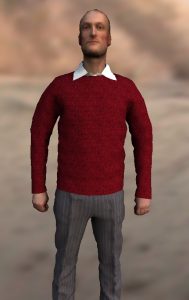
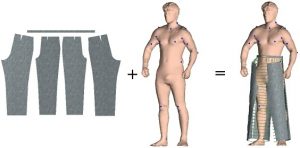
We give an ontology for garment patterns that can be incorporated into the simulation of virtual clothing. On the basis of this ontology and extensions to garments we can specify and manipulate the process of virtual dressing on a higher semantic level.
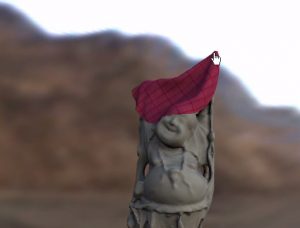
Collision detection is an enabling technology for many virtual environments, games, and virtual prototyping applications containing some kind of physically-based simulation (such as rigid bodies, cloth, surgery, etc.). This tutorial will give an overview of the different classes of algorithms, and then provide attendees with in-depth knowledge of some of the important algorithms within each class.
This paper summarizes recent research in the area of deformable collision detection. Various approaches based on bounding volume hierarchies, distance fields, and spatial partitioning are discussed. Further, image-space techniques and stochastic methods are considered.
In this paper we present a method for illuminating a dynamic scene with a high dynamic range environment map with real-time or interactive frame rates, taking into account self shadowing. Current techniques require static geometry, are limited to few and small area lights or are limited in the frequency of the shadows.
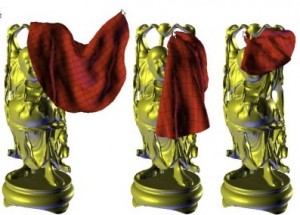
In this paper we address the problem of rapid distance computation between rigid objects and highly deformable objects, which is important in the context of physically based modeling of e.g hair or clothing.
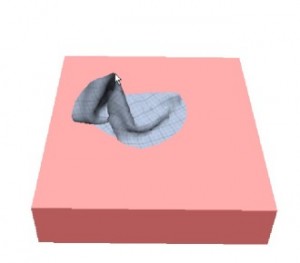
We describe a system for interactive animation of cloth, which can be used in e-commerce applications, games or even in virtual prototyping systems.
🏆 Computers & Graphics best paper award (2003)